No marketing team sets out to fail.
You launch a product or service you truly believe in; something that could solve real problems, save time, or make lives better. You plan content. You post regularly. You even boost your best work with paid ads.
But… nothing. Crickets. The engagement just doesn’t land.
You’re left wondering:
What are we doing wrong?
Why isn’t this working?
Here’s the truth: even great content will fall flat if it’s built on shaky ground.
Before you blame the algorithm or chase the next trend, ask yourself some hard but essential questions:
- Have you done your research? Not just the fun, creative stuff, but the boring-but-crucial market research?
- Do you know your business goals and the marketing strategy that’s supposed to get you there?
- Most importantly, do you really know your audience? Their pain points? Their daily struggles?
The question I always come back to is this:
“How can this content help improve just one person’s life?”
Because in any SaaS, PaaS, DaaS, or any acronym-driven business, for that matter, customers aren’t just important.
They’re the whole story.
The old-school saying was, “The customer is always right.”
Today, we say: “The customer always comes first.”
No users = no user journey. And no journey? Your product might as well not exist.
So if your content is flopping → don’t panic.
Let’s break down the five most common reasons why content creation fails, and more importantly, how to avoid each one like a villain.
So, What Happens When Content Creation Fails?
Let’s start with a success story: KitKat.
Their iconic slogan “Have a break, have a KitKat” has been around for more than 70 years. It’s not just a tagline; it’s practically a ritual. Be honest, how many times have you taken a quick break and thought, “A KitKat would be nice right now”?
Now, imagine if KitKat suddenly dropped that slogan. Imagine they scrapped their signature red packaging, their playful puns, their cheeky tone of voice.
What would be left?
Just another chocolate-covered wafer at a petrol station kiosk.
It would feel like there is no soul in a body. Without that familiar voice, KitKat would become forgettable, blending in with every other snack on the shelf. It’s their consistent, relatable, and human content that’s kept them relevant for generations.
Now flip the script. Let’s talk about Kodak.
Once a giant in photography, Kodak had every opportunity to remain at the top. They literally invented the first digital camera in 1975. But instead of embracing the future, they doubled down on nostalgia. Their messaging stayed stuck in the past, overly sentimental, out of touch, and completely disconnected from a new generation growing up on Instagram.
While their competitors leaned into digital content, influencer campaigns, and community-building, Kodak hesitated. By the time they attempted content marketing, it felt half-hearted and reactive. Their voice no longer carried weight. Their story no longer resonated.
In 2012, Kodak filed for bankruptcy.
Kodak didn’t just fail at content marketing; they failed to evolve their message when the world around them changed.
Why Content Is Important for Business Growth
Many companies struggle with content marketing not because they don’t believe in it, but because they’re unsure of the direction to take. Since content is intangible, it can feel less important compared to things that deliver immediate, measurable outcomes.
But they still expect tangible results.
And I totally get it. If you’re investing time and effort into creating content, you want to know if it’s working.
The key is to start by tracking the right KPIs. Measure what matters, monitor what’s gaining traction, and most importantly, listen to your customers. Their feedback will help you fine-tune your strategy and ensure your content is not just out there, but actually moving the needle.
How to Prevent Content from Failing
Hiring a content creator or even building an entire team won’t automatically fix your content problems.
Before you pour more resources into production, take a moment to reflect: does your message truly resonate with your audience?
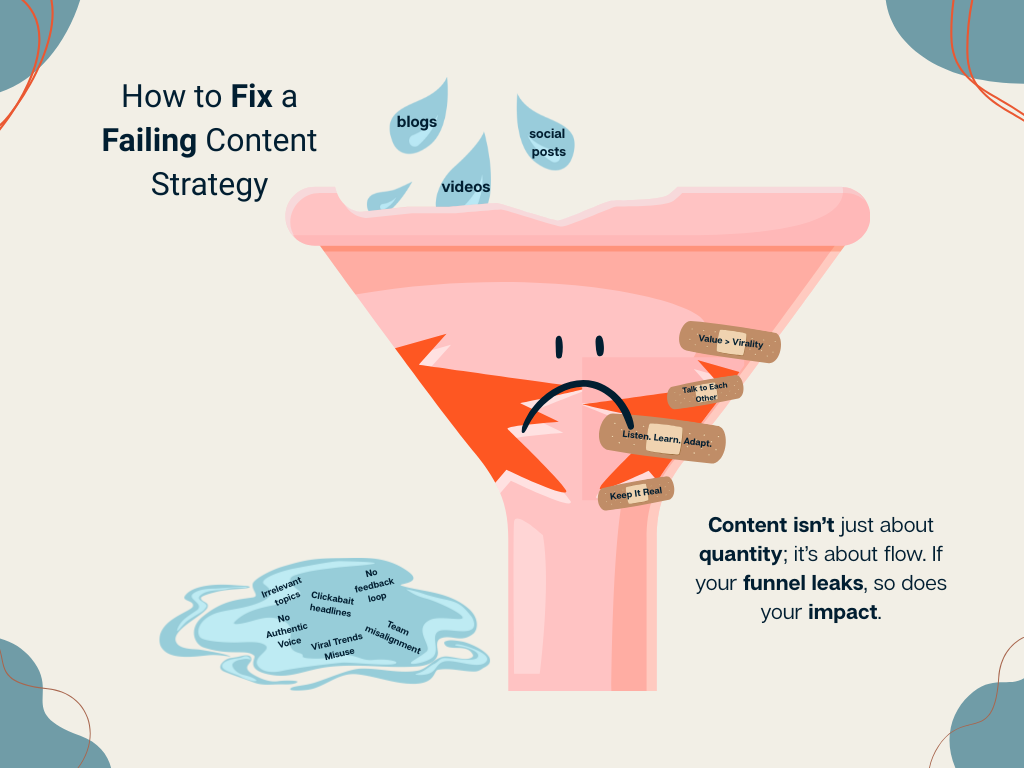
Here are five key reasons your content might be falling flat and how you can fix them.
Reason 1: Lack of Authenticity
Many brands lose their way by trying too hard to sound salesy or overly ambitious. You might think, “Here comes the marketing pitch again,” but hear me out.
If your headline says something like “10x your growth with smarter tools,” even you probably know it’s a stretch. For a company struggling with productivity, no single tool will magically increase output tenfold.
Instead, ground your messaging in real use cases. Who’s actually using your product? Maybe it’s small, agile startup teams of 20–80 people—not massive enterprises. So tailor your promise accordingly.
Try something like:
👉 “You handle the 6%, we’ll help you boost the rest by 4%.”
It’s honest, specific, and shows you understand your customer’s reality; not just their dreams.
Reason 2: Failure to Resonate
Just because something is trending doesn’t mean you need to jump on it. A viral Instagram Reel using Billie Eilish’s new track might not be the right fit for your product, and that’s okay.
But staying completely disconnected from cultural moments can also make your brand feel out of touch.
Sometimes, a well-timed meme or trending reference when it aligns with your brand’s tone can surprise your audience. It’s not about chasing trends blindly; it’s about knowing what your audience connects with and creating content that mirrors that connection.
Think of it like that physics formula you learned back in 7th grade, the one that finally clicked during a real-life situation just last week. When the context fits, everything suddenly makes sense.
The same goes for content.
Make it land, and your audience will listen.
(And yes—remember Kodak? That’s what happens when you stay stuck in the past.)
Reason 3: Poor Audience Experience
Yes, this is even a thing, and it matters more than you think. I always say, “Understand your audience, their challenges, and their pain points,” because that understanding is the lifeblood of good content.
It doesn’t matter if you’re selling half-baked cookies, weird services, or even mood rings that crack under pressure; if your content experience feels clunky, confusing, or irrelevant, your audience won’t stick around and will start to unfollow you.
Good content isn’t just about what you say, but how your audience feels while engaging with it. Is it clear? Helpful? Enjoyable? If not, they’ll click away and worse, they may never come back.
Reason 4: Misalignment Among Teams
Content and marketing teams aren’t just people with ring lights and phones, filming snippets to throw on social media. They’re your brand’s frontline listeners, tuning in to colleagues, customers, and even the office janitor to understand what’s really happening around.
But when internal communication breaks down, so does the message. If the product team can’t clearly articulate what problem the product is solving, the marketing team will struggle to translate that value. And if marketing can’t explain to sales why a newsletter takes priority over a social media push, then everyone’s rowing in different directions.
This kind of misalignment leads to confusing content, mixed messages, and ultimately missed opportunities. When teams don’t share context, content marketing fails before it even begins.
Reason 5: Ignoring Feedback
Ignoring feedback is like driving with your eyes closed—you might keep moving, but eventually, you’ll crash. Whether it’s coming from internal teams, loyal customers, or your broader audience, feedback is a valuable signal. People speak up because they care and want to help you improve. When brands dismiss that input, they risk growing out of touch—and ultimately, failing to evolve. Listening isn’t just polite, it’s strategic.
Steering Toward a Successful Brand
Let’s be honest, no amount of perfect timing or posting on the “right” channel will save your brand if you haven’t laid the groundwork for sustainable success.
Here’s what truly matters:
- Your content resonates with your customers on a human level.
- You’re creating content that hits the mark, not just fills space.
- People follow you because they find your brand genuinely useful, not just because of what you sell.
- Cross-functional teams actually understand and support the marketing strategy, instead of dismissing it.
- Your content team takes feedback seriously and doesn’t let ego get in the way.
No one wants to hand over success to their competitors, not because the product is weird, but because internal alignment fell apart.
Building a lasting brand isn’t easy. But if you’re intentional, collaborative, and strategic, the payoff is absolutely worth it.