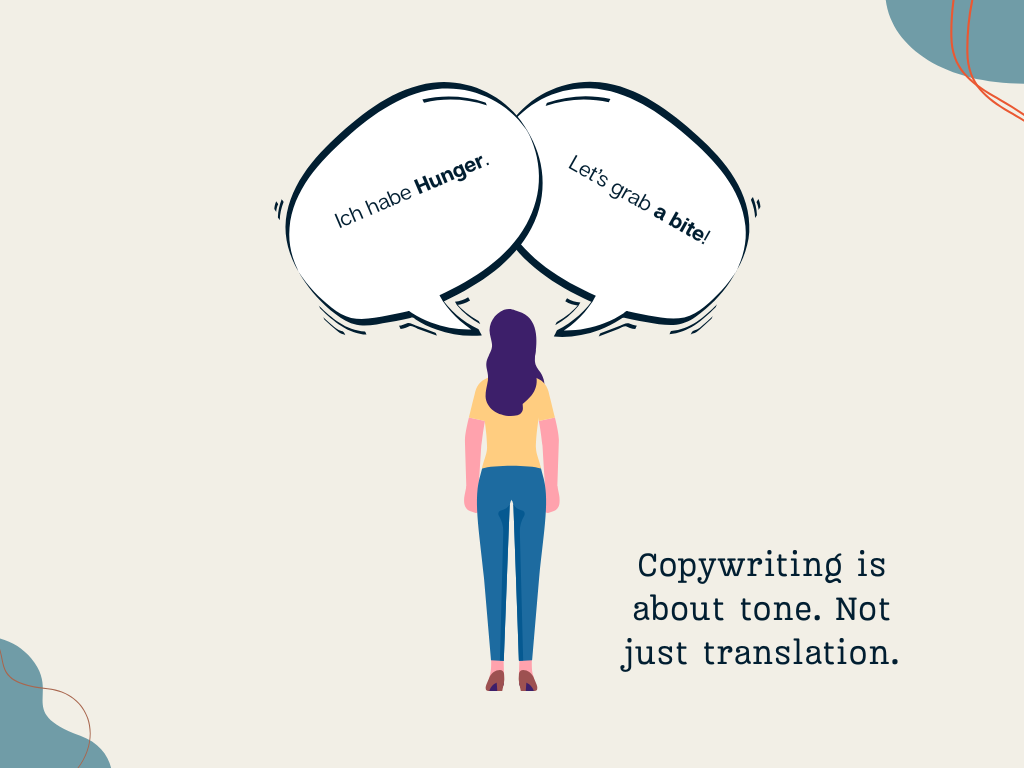
Learning a new language is all fun and games until your entire life starts depending on it.
It’s cute to pick up French or Spanish to toss a few words into conversation and sound a bit exotic. But when you’re navigating taxes, letters from government offices, or speaking to bank employees, you’d better know the right words (and fast).
I moved to Germany in 2018. And wow, did I underestimate the challenge. I naïvely thought, “It won’t be that hard. People here definitely speak English.” Well, yes… and no.
Sure, every third person I met spoke English well enough to teach it in school. But did they want to speak English with me? Not really. And I get it now.
So I had to adapt. I committed to learning enough German to survive the bureaucracy (God bless German paperwork) and hold my own in everyday life.
So what does this have to do with copywriting?
Quite a lot, actually.
I started my career as a social media manager, copywriter, ghostwriter, and corporate communicator. In all of these roles, my primary weapon has always been language. And moving to Germany tested everything I thought I knew about it.
At first, I thought, “This will be fun!”
(chuckles in danger, wipes sweat from forehead)
Learning German has been one wild ride. I’d learn a new word or phrase and feel invincible—until the next day when a fresh avalanche of grammar rules, idioms, and exceptions hit me like a truck.
Being someone who likes to learn fast, I started looking for shortcuts. But as the saying goes, “If you take shortcuts, you get cut short.”
And boy, did I learn that the hard way.
I’d write something in German, then run it through Google Translate to “double-check” it. My gosh, I’ve been delusional before, but never this delusional. What came out on the other side sounded absolutely nothing like what I wanted to say.
Case in point:
I once wanted to say, “I’m keeping my fingers crossed for you.”
I wrote:
“Ich halte meine Finger für dich gekreuzt.”
…which is wrong. 😅
The actual phrase?
“Ich drücke dir die Daumen.”
(Literally: “I’m pressing my thumbs for you.”)
See what I mean? If I had said that in public, I’d either sound like I was joking or just clueless.
Here’s another example: KFC.
Their famous slogan is “Finger lickin’ good.”
But in Germany? The official tagline is: “Legendär lecker” (Legendary tasty).
Why? Because “Finger lickin’ good” doesn’t translate naturally or comfortably into German. A literal version like „Zum Fingerablecken gut“ or „Fingerleckend gut“ sounds… clunky, weird, and slightly gross.
Could KFC have stuck with its iconic English slogan? Probably. But that’s where glocalization comes in—brands want to sound local, not foreign.
That’s when it clicked:
Learning German made me a better copywriter in English.
I planted one seed and ended up growing two flowers.
As a young copywriter, I was all about witty one-liners, catchy hooks, and clever phrasing. But learning German made me slow down and prioritize understanding.
German is a structured, efficient, no-fluff language. It taught me how to write with clarity, purpose, and function. When I stopped translating from English and started thinking in German, everything changed—even my English writing.
Now, I aim for simplicity. Precision. Personality.
Copy that doesn’t just sound good, but feels right.
Real-life proof from my bathroom shelf:
Let’s take NIVEA. Their tagline in Germany is:
„Pflegt die Haut. Schützt die Umwelt.“
(“Cares for the skin. Protects the environment.”)
It’s short, clear, and effective. No fluff, no frills. And yet super impactful.
P.S. A little email insight for my fellow writers:
You know how we usually start emails with:
“Dear, I hope this email finds you well.”
Well… in Germany, that’s a dead giveaway that the message was translated. Germans skip the pleasantries and go straight to the point.
→ No fluff. More function. (Toldya.)
Final takeaway: Adapt. Don’t translate.
I’ve stopped translating blindly. Now, I focus on understanding the meaning and choosing words that truly fit. Funny enough, every time I look up one word, I end up learning three. It’s a great side effect.
Even though I rarely write copy in German, whenever I need to send a message or write a letter, I now take the time to find the right words—not just the closest ones.
Because I’ve learned:
You don’t write for the language.
You write for the reader.
A note to fellow writers and businesses:
If your brand speaks more than one language, your message should too.
It’s not just about the words. It’s about how they make people feel.