When I first started working, the term UI/UX designer sounded incredibly technical—like someone with two Master’s degrees in Machine Learning and a background in Computer Science.
While that’s not entirely wrong, what I didn’t realize back then was just how human-centered their work really is.
UX designers need a deep understanding of human behavior because their goal is to create products that make everyday life easier. That calorie-tracking app you casually use? It was likely designed by someone who obsessed over every detail to make it intuitive, seamless, and genuinely helpful.
So, what can UX teach a copywriter like me?
Honestly? A lot.
It wasn’t until I began working closely with UX designers that it clicked: whatever they map out visually and structurally, I translate into words. My role became about guiding users through a journey the designer had already thoughtfully crafted.
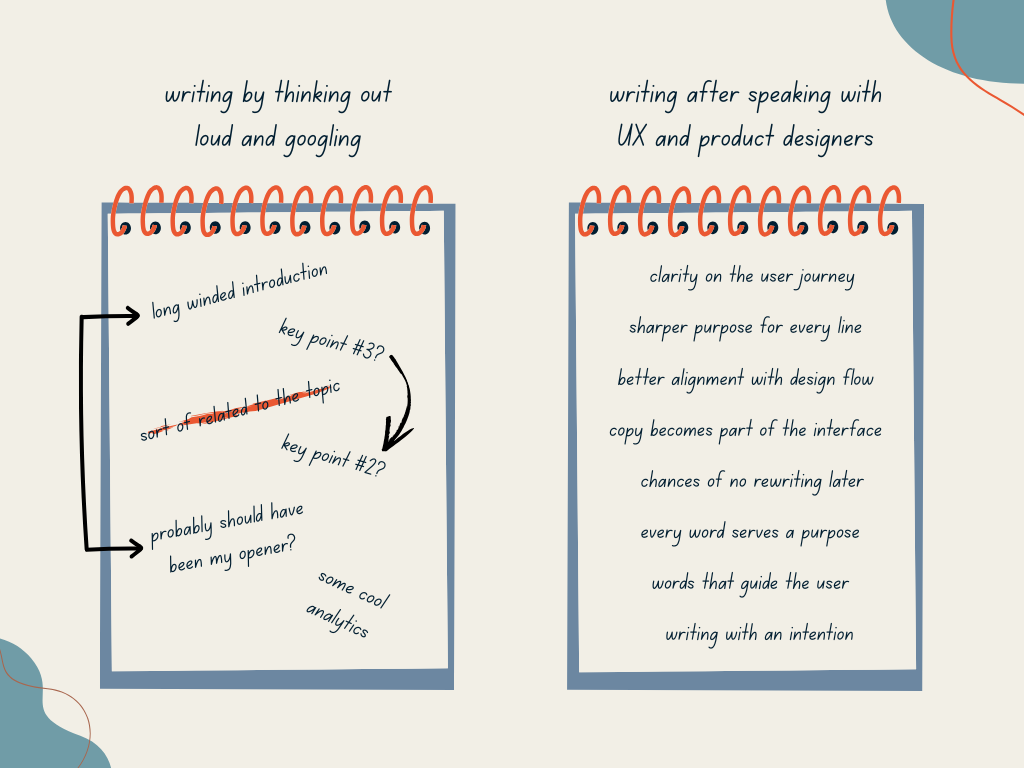
Before this collaboration, I spent hours doing secondary research—reading articles, exploring best practices—just to figure out where to begin. But working directly with UX teams gave me first-hand insight. I started thinking like a user, not just a writer.
Suddenly, my writing had more purpose. I wasn’t just crafting features or CTAs—I was walking through users’ pain points and helping solve them. Together, we weren’t just building a product.
We were building understanding.
How My Writing Skills Transformed
I’ll admit it: while my writing is strong and I can explain context clearly, my design skills are the complete opposite. When it comes to design, I’m a total noob. I can sketch on paper to show how my ideas or content might flow, but using tools like Figma (or even Canva Pro)? Not my thing.
But this UX-copywriting collaboration taught me something beyond words.
Active Listening
I used to sit hunched over my laptop for hours, juggling tabs, reading endless resources, Googling for the most precise answers, even digging through customer reviews just to find that one hook to kickstart my writing. Honestly, it was exhausting.
But everything changed when I started listening (like really listening) to product designers, developers, and UX consultants. I have to admit, once I did, my writing began to flow more naturally.
That’s when I realized the power of listening. It activates the problem-solving part of your brain. When you’re actively engaged in listening to someone, your thoughts shift from “Where’s the answer?” to “Oh, maybe ‘this’ could be the solution.” It becomes less about searching and more about understanding.
Copywriting Takeaway:
Writing isn’t just about words; it’s about connection. Make your readers feel like they’re on a guided journey, not stumbling through a maze thinking, “Wait, what did I just read?”
- Let the design lead, and your words follow with intention: If the design already speaks volumes, your copy doesn’t need to shout. Think about Apple’s website: stunning visuals, infinite scrolls through the product, and just a few powerful, well-placed words.
- Connection is in the details: Remember that witty email subject line that made you click instantly? Those tiny moments are where real connection happens.
Thinking Visually
You know those movie scenes where the actor is writing something but is drowning in a swirl of words, paralyzed by overthinking? That was me, stuck in a loop of second-guessing every line, until I started thinking visually.
Now, I know this might sound like something a wannabe motivational speaker would say just to sound deep. And trust me, this mindset shift in me didn’t happen overnight. It started when I began actively listening to UX and product designers. They walked me through the user journey, step by step, and that helped me build a mental map of how things flow. Suddenly, the words found their rhythm.
I’d think, “Okay, there’s a loading delay here so maybe this is where I can add a witty one-liner or even something simple like ‘Don’t forget to drink water!’ to keep users engaged.”
That’s when I realized: I wasn’t just writing → I was co-creating an experience.
“Hey Alexa, play Unstoppable by Sia.”
Copywriting Takeaway:
Your writing is part of the design. Copy shouldn’t feel like an afterthought. It’s what creates micro-interactions and guides users along with the visuals. If one element falls short, the whole experience wobbles.
- Consistency is everything: Imagine opening a newsletter with beautifully structured headings and paragraphs at the top, and only random images at the bottom. It feels disconnected, like the copy and design teams had a falling out. Great UX happens when both work in sync.
- Communication is your superpower: If you think a CTA needs more than two words, just say it. If you feel the flow could be smoother with an extra line, talk to the designer. Most problems in the creative process can be solved with a little honest conversation.
Matching Context
When I write articles, CTAs usually flow naturally from the content. But in UX, it’s not just about flow; it’s about fit. If there’s a button, I can’t just slap on an action verb and call it a day. The CTA needs to align with what the user is doing, expecting, or needing in that exact moment.
Now, instead of filling space for the sake of “finishing,” I pause and ask: Does this really belong here? Think of it like puzzle pieces. Just because something looks like it could fit, doesn’t mean it actually does. A CTA might seem right length-wise, but visually or contextually, it might throw the whole experience off.
Copywriting Takeaways
Websites, apps, and products can sometimes feel like puzzle games. Faced with endless menus, dense text, or legal jargon, users just want to know: What does this do for me? Do they really need to read 387 lines of a privacy policy, or could you just highlight the 3 that actually matter to them right now? Your job as a designer or writer is to simplify the journey. Make the important pieces stand out, and make the path feel obvious, not overwhelming.
- Tie the perfect bow: It’s all about bringing everything together seamlessly. Take Netflix, for example, the sign-up flow ends with a simple, powerful CTA: “Start watching now.” Design and copy, perfectly in sync.
- Reduce confusion with clarity: Words are your tool—and your responsibility. If something in the design feels unclear, your copy can guide, clarify, and comfort. Don’t underestimate the power of well-placed words.
Sharpen Your Words
As writers, we love giving context. We love building a story. But working with UX teams taught me something else: clarity > cleverness, especially when space is tight.
Think of a tiny button or text box. You can’t fit a whole paragraph there. It needs to be crisp, direct, and purposeful. CTAs like “Download now,” “Subscribe,” or “Redeem coupon” aren’t lazy writing. They’re smart writing for fast-moving users.
Yes, we love being gentle and expressive. But today’s users want shortcuts, not soliloquies. They don’t want to think more than they act (okay, not everyone, but you get the point). That urgency is what drives action more than a beautifully crafted sentence ever will.
Copywriting takeaway:
Leverage urgency, but ethically. Use the psychology of FOMO, immediacy, and emotion to nudge users into action. But always keep it user-first.
- Let your words play with the design: If the interface is fun and playful, don’t write like a legal disclaimer. Match the tone. Great UX writing isn’t just functional — it feels like something. Think of it like this: the design is the concert poster, but your words are the friend who leans in and says, “Wait, you’re coming too, right?” One gives the info. The other sparks the reaction.
Final Thoughts
I’ll likely keep updating this blog from time to time or maybe even create a second version down the line. After all, I’m learning something new every day through the work and projects I’m part of.
What I’ve come to realize is this: UX and writing are remarkably similar, yet beautifully distinct. One communicates through visuals, the other through words, but both share the same goal: to guide, inform, and shape a seamless user experience.
So the next time you write for a product, website, or app, channel your inner UX designer. Make every word count, and most importantly unforgettable.