Did you like the final episode of Squid Game Season 3?
Chances are, it left you amazed or left you slamming your laptop shut in frustration. Either way, one thing’s for sure: the ending matters a lot.
I am no TV critic, nor any guru to judge what’s best and worst, but as someone who writes for a living, I do know how easy it is to lose steam by the time you reach the finish line.
You start writing with excitement, full of ideas and dreams. The intro’s catchy, the middle is solid, and then suddenly, when it’s time to wrap it up, you’re grasping at straws, just trying to land the piece somehow.
I, myself, have been there. In cases when the topic is something I love, I’d pour so much into the beginning and the middle that I’d forget to save some for the end. The ending is the reader’s last impression. And just like any TV show or film, that final moment is what shapes how the entire piece is remembered.
So in this post, I’m sharing some of my favorite ways to end a piece of writing with intention and impact. These tips can apply to blogs, captions, video scripts – you name it.
(Save them for later; your future self will thank you.)
Cliffhangers
I can’t help myself but I had to share my favorite tip right at the beginning. Let’s go back to Squid Game (SQ) as an example. The writers did something clever: they left us with a cliffhanger. Not a full stop, but a semicolon leading to countless possibilities.
Will the story continue in other regions? Does it end here with the haunting reminder that “we are not horses, but humans”? Or is the audience meant to fill in the blanks with their own imagination?
So many directions and only time will tell where it all leads.
Now, if you’re familiar with cliffhangers, you might be wondering how to create one that feels intentional, not incomplete.
Here’s the key: don’t confuse a cliffhanger with withholding information. A mystery leaves readers frustrated when it feels like you’ve broken a promise, like skipping the reveal of that one secret you kept hinting at.
A cliffhanger, on the other hand, gives closure and opens a new door. Wrap up the arc you started, but hint at something bigger just around the corner.
In Squid Game Season 3, for example, while Player 456 meets his end, several new threads begin to unravel, like his daughter, the baby (who might grow up and uncover the truth behind the games), Sae-byeok’s younger brother, or even Pink Soldier 11.
Each one of these hints at a future storyline, without leaving us a light at the end of the tunnel
Whatever path you take, make sure your cliffhanger supports your story, not just adds drama for the sake of it. When done right, it’s the kind of ending that keeps readers thinking and coming back for more.
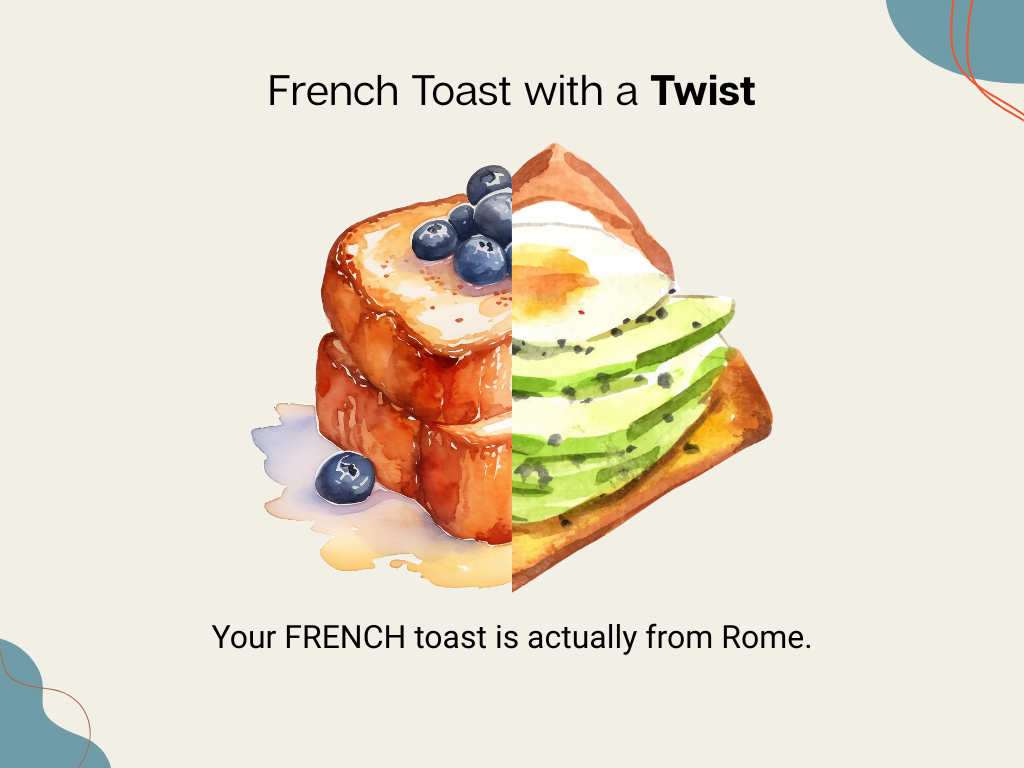
French toast with a twist
Here’s the plot twist: French toast didn’t originate in France.
It dates all the way back to ancient Rome.
I had the same reaction. It felt like my whole life had been a lie.
But it gets even twistier. Some people love their French toast savoury, with sausages, eggs, and a squeeze of ketchup, while others enjoy it as a sweet treat topped with berries, cream, or syrup.
This just goes to show that even something as simple as French toast can have layers. And that’s exactly what your writing needs, especially at the end.
A good twist at the end of your piece can surprise your readers, leave them thinking, or give them a reason to come back for more. But here’s the catch: the twist has to make sense. It needs to feel like an “aha” moment, not a “wait, what?” derailment.
Take the French toast example again. Finding out it comes from Rome is surprising, but still believable. Italy and France share a border, so the connection feels natural.
Now imagine if someone told you that French toast comes from Australia, and it’s called “French” because the milk is imported from France. That’s not a twist. It’s just confusing (and retarded.)
Bonus Tip: If you want your twist to land, drop a few subtle hints throughout your piece. When readers reach the end, they’ll feel rewarded for paying attention. That’s when you know you’ve nailed it.
Where the story ends, curiosity begins
This tip is closely related to the first one → cliffhangers.
The only difference is that with cliffhangers, you leave your story or article at an exciting pause, knowing that you can come back later to continue or expand on the topic when you have new ideas or updates. For instance, you might write an article that ends on a cliffhanger, and later, when you’ve gathered more information or developed new characters, you can pick up where you left off.
Leaving some questions unanswered takes a different approach. Instead of providing all the answers, you invite your readers to engage more deeply by sparking their curiosity. When you end an informational piece with thought-provoking questions or unresolved points, your reader is encouraged to explore further. They might ask others, Google it, or even turn to AI for answers. This method not only keeps readers thinking long after they’ve finished reading but can also inspire those who weren’t initially interested to dive deeper into the topic.
Pro tip: Leave your readers with enough open-ended questions that evoke reflection and curiosity, not confusion or frustration.
Bring it all together
Well, it might not sound like the most intriguing plot twist, but that’s exactly how sitcoms like F.R.I.E.N.D.S wrapped up. Sure, the show had its fair share of cliffhangers along the way till the end, but what about the big questions left hanging? What happened to Joey 10 or 15 years down the line? Did he really grow old in Chandler and Monica’s guest room? And what about their twins? Or Ross and Rachel, Phoebe and Mike?
Those unanswered questions stick with you, and they’re kind of wild to think about. Yet, despite leaving some mysteries open, the story still came full circle. As viewers, we felt a sense of closure and satisfaction. That’s a great way to finish your content: showing growth and resolution while leaving a bit of room for imagination. Just be careful not to wrap things up in a way that feels too neat or predictable. It can come across as boring, making your audience think, “Yeah, I totally saw that coming,” and lose interest with a yawn.
Novels and TV Shows with Great Endings (No Spoilers)
Here are some TV shows and novels that have inspired me, each with endings that resonate deeply and leave a lasting impression:
- Adolescence (Netflix, 2025)
This series circles back to where it all began – Jamie’s bedroom. The ending is deliberately open, filled with unanswered questions and subtle hints that resist easy interpretation. Yet, the emotionally charged finale lingers long after, inviting viewers to reflect on what might have been. - Mo (Netflix, Season 2)
Packed with highs and lows, this show closes on a bittersweet note that teaches the beauty of complexity. The deeply personal narrative leaves room for imagination, whether there’s a Season 3 or not, fans are left contemplating what lies ahead for Mo, his mom, and brother, crafting their own hopeful futures for them. - To Kill a Mockingbird by Harper Lee
A classic that wraps up with powerful lessons learned. Scout’s journey culminates in a firm stance against prejudice, embodying hope and resilience. The ending inspires readers to stand up for justice and compassion. - Never Let Me Go by Kazuo Ishiguro
A haunting and poignant conclusion that stays with you long after the last page. The novel’s subtle yet profound ending invites deep reflection on memory, love, and what it means to be human. - Breaking Bad (AMC)
A masterclass in storytelling, this series finale ties up its intense narrative with precision and emotional impact. The resolution balances closure with complexity, rewarding viewers with a satisfying yet thought-provoking conclusion.
If you’re struggling to end your story, here’s why it’s a good sign
John Lennon said, “Everything will be okay in the end. If it’s not okay, it’s not the end.” When finishing your story feels tough, remember this: struggle means your story isn’t finished yet. There’s still room for a stronger ending or a true resolution that brings peace. Keep pushing, keep refining, and don’t stop until your story’s ending feels just right.