“AI will take your writing job soon.”
“ChatGPT can write better than most humans.”
“Aren’t you scared AI will replace you?”
Yeah, I’ve heard them all, and I’m tired and bored with them.
If you’re one of those people convinced that AI will make copywriters obsolete, let me stop you right there. AI can do many things, but it can’t pull juicy, soul-stirring stories from someone’s childhood, heartbreak, or awkward first internship. It doesn’t have the human messiness that great storytelling often needs.
Is it 100% impossible for AI to take over one day? Of course not. This is the 21st century. But for now, let’s be clear: AI isn’t here to replace your job. It’s here to enhance it.
I wasn’t around during the “computers will take our jobs” panic, but I imagine it felt a lot like the AI anxiety we see today. And guess what? Computers didn’t eliminate jobs; they created entire industries. No computers, no coders. No coders, no ChatGPT.
So, after all this talk about AI, let’s get to the point: how can AI actually help us in content marketing?
Whether you’re a marketer in Stuttgart or a startup founder in Sydney, AI can be your secret weapon if you use it right.
Let’s dive in.
How AI Can Improve Your Content Strategy
Marketing takes time, creativity, and a little bit of madness. No marketing team runs without someone turning a real-life crisis into a joke just to cope. While AI may not bring that level of unhinged brilliance, what it does bring to the table is structure, speed, and focus.
I won’t lie, but there have been plenty of times when I got distracted or overwhelmed, and AI helped me refocus, organize my thoughts, and even spark new ideas.
That’s why I see an AI-powered content strategy not as a replacement for creativity, but as an enhancement – kind of like makeup for your ideas. It doesn’t hide the real you; it just brings out your best features.
Here’s how AI has genuinely helped me:
Smarter Topic & Keyword Research
I’m a big fan of Semrush, and it’s been a game-changer in my workflow. It helps me discover trending topics, long-tail keywords, and uncover content gaps I wouldn’t have found on my own.
Instead of guessing keywords like “plumbers near me” and hoping for the best, Semrush shows me what people are actually searching for, what’s ranking, and how difficult it is to compete for those keywords. With its AI-powered features, I can now make smarter, data-driven decisions and adjust my strategy to specific markets, even down to language and location, like Stuttgart or the wider DACH region.
Faster Content Creation (Without Sounding Like a Robot)
Tools like ChatGPT, Perplexity, and Claude.ai have become my go-to writing assistants. I don’t use them to write full articles for me, but I do use them to write with me.
Here’s how it works: I’ll start drafting something like a story from real life or a more formal paragraph, and when I hit a wall or feel there are gaps, I bring in AI to help fill those blanks. This forces me to think critically while letting AI support the structure, tone, or flow. It’s like having a second pair of (non-judgy) eyes on my draft.
If you try this, you’ll still be in control of your voice. AI just speeds things up, so you spend less time stuck staring at a blinking cursor and more time polishing your ideas. Think of it as your always-available, never-moody co-writer.
Content Calendar Planning with the Chaos
Out of all the tasks in content creation, planning the content calendar has to be my least favorite. Why? Because no matter how perfectly I map it out, something always derails it, especially when I’m juggling multiple platforms.
But here’s where AI became my secret weapon (and maybe even a personality booster). Tools like Notion AI have helped me cut through the noise. They analyze past performance and suggest the best times, formats, and platforms to publish, so I don’t have to spend two hours every Friday trying to figure out what went wrong and how to fix it.
Even better: These tools can auto-generate a 30-day content plan based on your team’s specific goals, whether it’s boosting traffic, improving engagement, or building brand authority. Honestly, it’s like having a personal strategist who actually meets deadlines.
Of course, there are plenty more ways AI has supported my content marketing journey. But these three stand out the most, for now. Let’s just say that the rest are still works in progress, and I’d rather not jump to conclusions until the results are clearer.
Now, let’s move on to something we all need to talk about: the common mistakes people (myself included!) make when using AI in marketing. I’ve definitely had a few facepalm moments, and who knows, maybe you’ll spot a few familiar missteps too?
Common Mistakes When Using AI in Marketing (And How to Avoid Them)
Like I mentioned earlier, writing with AI tools can supercharge your workflow, but only if you know how to use them strategically. Here are the most common pitfalls I’ve seen marketers (myself included sometimes) fall into, and what to do instead:
1. Skipping the Fact Check
Please, for the love of all that’s holy, it’s 2025. Don’t believe “Australia is wider than the moon” just because AI said so. The thing with AI-generated content is that it can sound very confident even when it’s completely wrong. This can be dangerous if you’re writing about tech, pharmaceuticals, finance, or any industry where accuracy is critical.
What to do instead: Treat AI like a lightning-fast researcher, but always verify its claims. Ask subject-matter experts, dig into credible sources, and make sure you’re not about to publish something as bizarre as “Australia is wider than the moon” (it’s not).
2. Ignoring SEO Best Practices
SEO might sound outdated, but it’s not dead yet. Many people now rely on AI to get answers instantly instead of reading five different articles, but here’s the catch: AI still learns from high-quality, well-optimized content on the internet (wink wink).
What to do instead: Use AI to sharpen your keyword research. Many tools now use machine learning to suggest keyword density, related topics, headings, and even meta descriptions, helping you create content that’s both reader-friendly and search-engine-friendly.
3. Letting AI Write Everything for You
I’ve done plenty of embarrassing things in life, but never have I ever let AI write my whole article. Only once, back when I first discovered it. Out of curiosity, I typed in: “Write an article about the myths of solar power.”
Sure, it looked great at first glance, but most of it was fake. It’s like someone put the “ugh” in “laugh.”
What to do instead: Use AI as your assistant, not your ghostwriter. If you’re scared of the blank page, let AI help you build the structure. Then, add your own stories, examples, and insights to make the piece human. AI should write with you, not for you. Keep your authentic voice, let AI handle the boring bits, and always edit AI drafts before publishing.
4. Still Doing Tedious Tasks Like Managing Content Calendars
Manually planning a content calendar is exhausting, especially when you’re posting across multiple platforms.
What to do instead: Let AI handle the heavy lifting. Tools like Notion AI, CoSchedule, or even AI-enhanced Trello can analyze past performance, suggest the best publishing times, and auto-generate a 30-day content plan based on your goals. Give AI the repetitive, data-heavy work so you can focus on creativity and strategy.
Final Thoughts: Should You Rely on AI for Content Marketing?
This is a strong note to end on, but it’s worth saying.
AI tools can be addictive. Once you start using them daily, it’s hard to imagine working without them. The moment a server goes down feels like an eternity, and frustration creeps in fast. That’s already a sign of reliance.
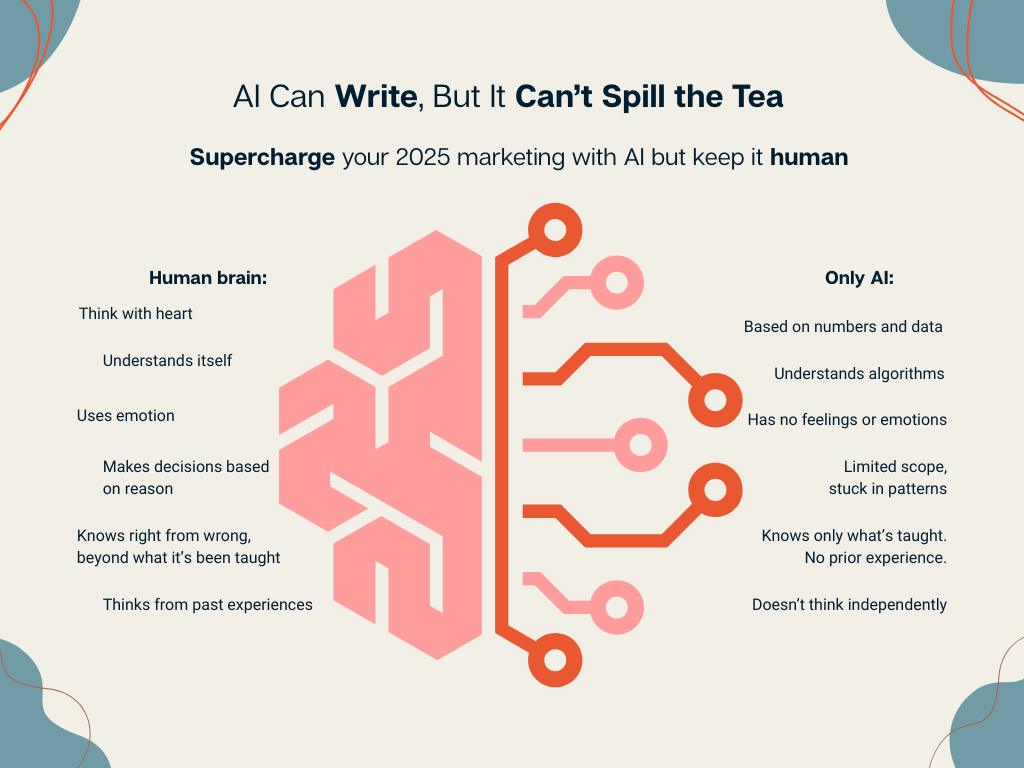
In the long run, I still believe it’s not wise to depend on AI for everything. Sure, it’s brilliant for planning, organizing, data analysis, and brainstorming, but it can’t capture raw human emotion. What I pour into words from experience and feeling, AI simply processes as 1s and 0s.
All in all, AI can never replace you. So be yourself because AI is already busy trying to be everyone and everything else.